
But How Do You... Stop Holding?
...even the laws of physics are not immune to my trust issues.

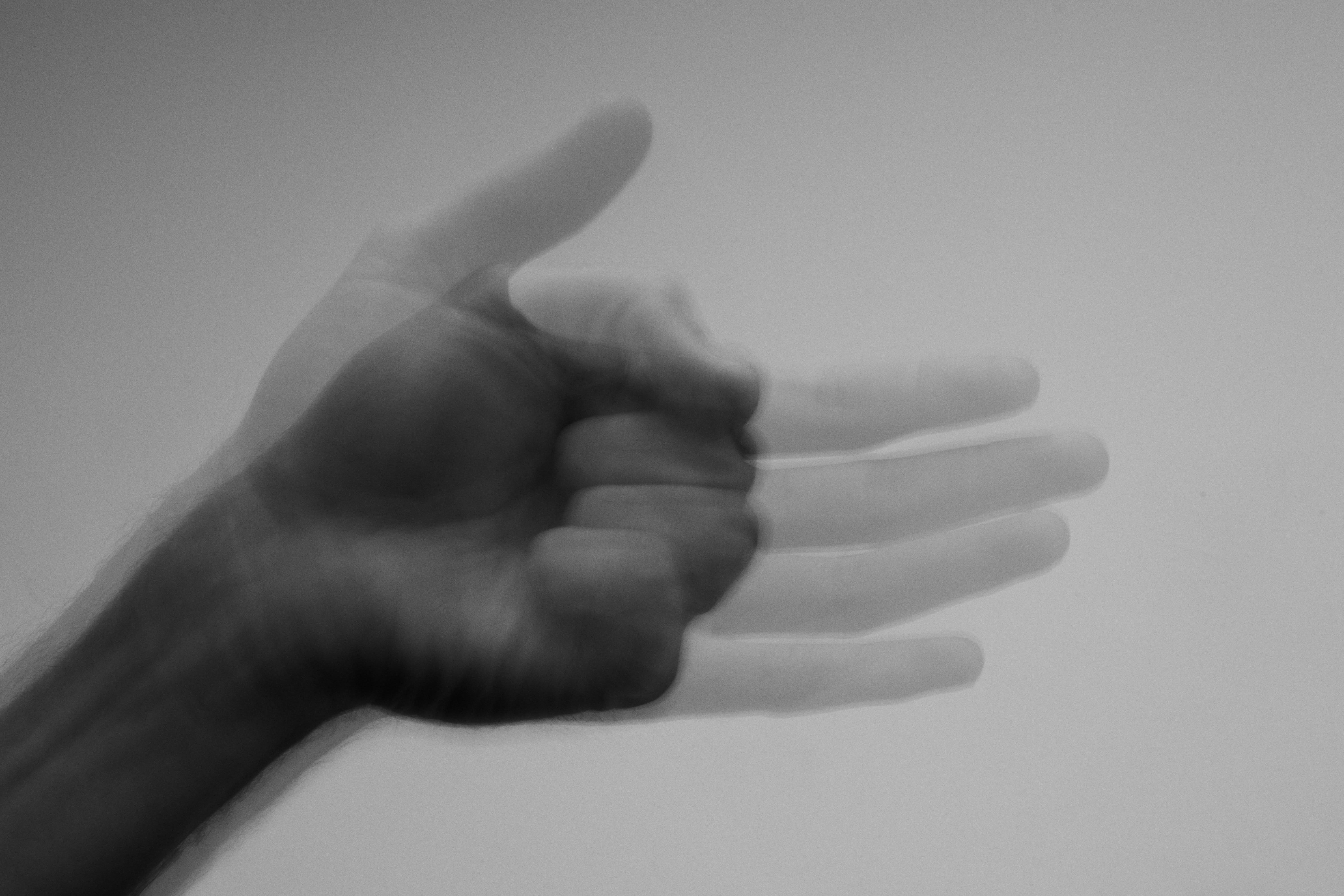
In December of 2020, unable to travel home for the holidays, my late husband, Gavin, and I received a Christmas care package from his parents that included special gingerbread cookies pressed into the shape of delicate cracked and crinkled snowflakes. Stuck to the outside of the lovingly packed Ziploc bag was a post-it note that read, “Don’t know how strong they are, start with one. Love, Mom.” A few weeks later, after dabbling in these special treats, we took our dogs out for a bedtime walk. Gavin was in the lead walking Reynolds, while I followed up behind with our slower senior, Felix. Half a block into the walk, Gavin looked down to see Felix jauntily trotting past him, the leash swishing along the sidewalk behind him. Gavin picked up the leash and handed it back to me, only to watch me drop it again. I looked at him and made a grasping hand gesture that was somewhere between an Italian pinched fingers emoji and an upside down jellyfish and asked, very seriously, “but how do you… hold?” Gavin laughed, took Felix’s leash in the same hand as Reynolds’, held my hand in the other, and walked the three of us home.
The question of, “how do you… hold?” became a running joke between us after that, and we would replicate the pulsing pinched-fingers-jellyfish hand gesture to ask each other how to perform simple tasks that were proving to be not-so-simple. What I’ve come to realize over the last few years, however, is that it isn’t the holding I struggle with. It’s learning how to put things down.
In one of my first therapy appointments in 2021, I was asked to hold a pile of small, smooth pebbles in both hands. With my hands full, my therapist started to gently lob more pebbles towards me, asking me to continue catching them until the rocks overflowed, bouncing and sliding off onto the floor. Message received, I thought, but I didn’t fully get it. Not yet.
A couple of weeks ago, towards the end of a massage appointment, my RMT asked me to walk down the length of the hallway in the clinic and then turn around and walk back. As I walked away from her, I was invited to visualize that the floor was supporting me with each footstep. On my return trip, I was asked to visualize that I was supporting the floor. “How does that feel?” she asked, after a couple of back-and-forths. I thought for a moment and then replied, “When I walk away I feel heavier. When I come back I feel more buoyant.” Her next question was, “Which feels more comfortable?” “Oh, definitely the return trip,” I immediately replied. As a scientific theory I fully believe in the principle of gravity, but as it turns out even the laws of physics are not immune to my trust issues.
There is nothing easy about the early stages of deep grief and loss. It is a voracious monster that consumes everything and threatens to swallow you whole. But if there was a silver lining to the magnitude of those emotions, it was that I had to feel them. My body and my heart gave me no choice. Now, 2.5 years after losing Gavin, it feels easier to slip back into old patterns of suppressing and avoiding feelings that feel too messy, too much, or too complicated. I can now choose not to be the woman crying in the grocery store because her dead husband’s favourite snack is on sale, but when I turn away from those feelings, where do they go?
It’s been just over a year since I returned from my yoga teacher training in Panama and dipped a toe, and then a foot, and then my whole self into the foreign ocean of dating as a bisexual millennial widow. As my new relationship continues to deepen and grow, there have been many moments where I’ve questioned my ability to hold all of the love, grief, and bittersweet joy that comes with building a new life out of the ashes of my old one. Like any good over-achieving people pleaser, I assumed this required more from me. More expansion, more capacity, more stretching of a heart that already holds so much.
Our bodies only need about 90 seconds to process emotions if they’re given the space to be felt and released, but so often we deny our feelings this space, or we get stuck in our heads and trapped in a loop of overanalyzing that leaves us emotionally exhausted without any release. I’m guilty of all of this, and of intellectualizing my way through therapy in a way that earns me “good girl” gold stars while bypassing the mess of really feeling my feelings.
But these methods aren’t working. I’m exhausted and my pebble-filled hands have no space to hold any more, and maybe they aren’t supposed to. Maybe the goal of therapy and breathwork and somatic healing isn’t to continually stretch myself until I can hold all-the-things-all-the-time. What if the real goal is to give myself the space and time to sit in each feeling as it comes, even if that does involve a soft, quiet cry in public (again)? And, maybe the hardest part, when the 90 seconds is over, can I give myself permission to fully let it go? Can I trust that letting go of a feeling doesn’t mean letting go of the love behind it? But how do you… trust?